
From Idea to Song – How We Create New Music

Where does a song actually come from? Many people picture songwriting as someone sitting alone at a piano, waiting for inspiration to strike. That can happen — but at Luxicals, our creative process looks very different. For us, writing original music in Luxembourg is a collaborative journey, and almost every song we perform began life as a shared idea in a room full of voices.
Different songs for different stories
Not every song begins the same way. Some are written for a musical production and become part of a story — they introduce characters, carry emotion, or push the plot forward. For our original musical Grand Hotel Wellington, several numbers were written specifically to serve the storyline and bring the characters to life. One example is the opening number, Welcome to Grand Hotel Wellington:
Welcome to Grand Hotel Wellington
An original number written for our musical.
Songs like this are created with a very specific dramatic purpose: they have to fit the scene, the characters and the emotions of a particular moment.
Other songs are written for a special occasion, a concert, or a particular time of year. Something Magical, for instance, started life as an idea for one of our Christmas concerts and grew considerably through rehearsals and group discussions:
Something Magical
Our original Christmas song.
And sometimes a song grows out of personal experience and emotion. Our Friend in the Sky was written during a very difficult time for our group. The loss of our friend and mentor Theresia affected many of us deeply, and music became a way to put those feelings into something we could share:
Our Friend in the Sky
An original song in loving memory of Theresia.
Music can sometimes say what ordinary words cannot.
It all starts with an idea
Every song begins somewhere. Sometimes someone brings a title; sometimes it is just a single line, an emotion, a melody, or a simple question. One person might plant the first seed — but from that moment on, the whole group gets involved.
This is perhaps the biggest difference between our process and traditional songwriting. You do not need to play an instrument to take part. You do not need to be able to read or write music. Ideas, stories, emotions and lived experiences are every bit as valuable as melodies and harmonies. Everyone can contribute. Together we shape lyrics, develop melodies, test harmonies and build the structure of the song until — little by little — a complete lead sheet with words and chords starts to take form.
The first piano version
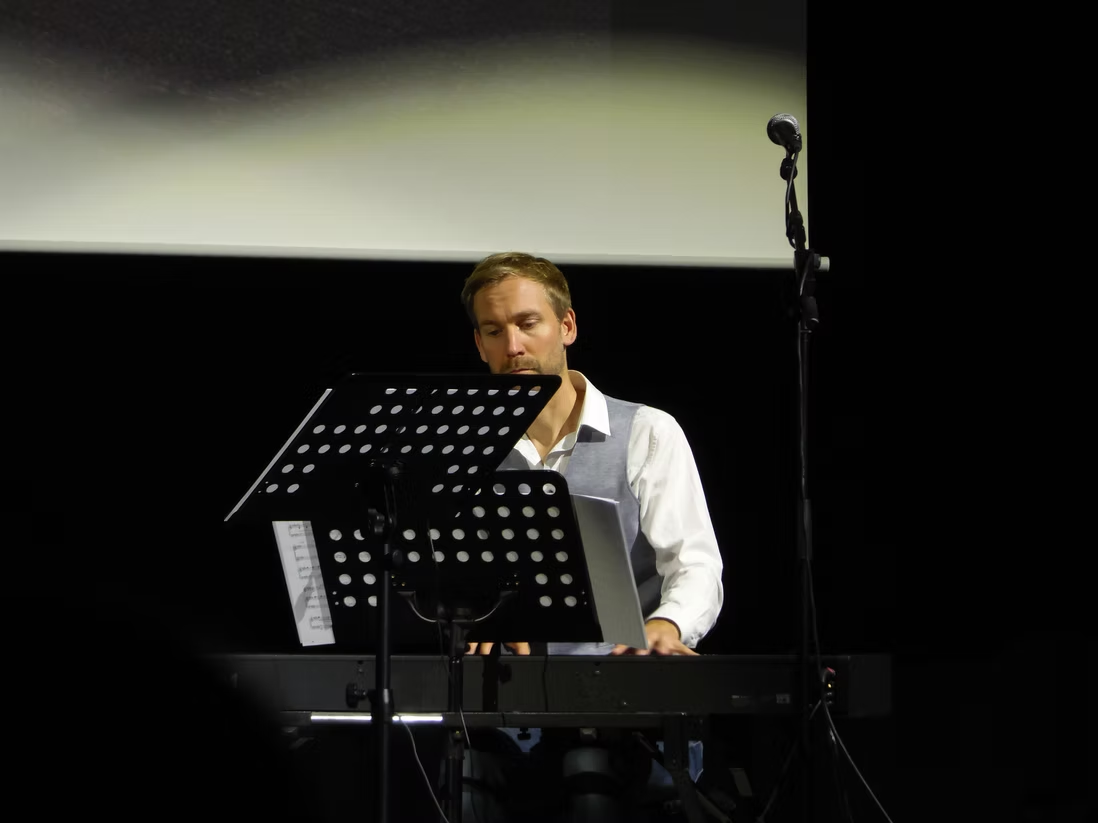
Once a first version exists, we usually make a piano demo. This is where our work with composer, musical director and pianist Philipp Polzin becomes invaluable. Philipp helps us turn rough ideas into playable arrangements, and lets us hear a song properly for the very first time. These early piano versions are essential, because they let us test:
- Vocal harmonies — how the voices sit together.
- Choir and ensemble arrangements — what the song becomes with the whole group.
- Emotional impact — whether the song lands the way we intended.
- Storytelling — how the lyrics carry the narrative.
- Musical structure — verses, choruses and the overall shape.
At this stage, the song is still very much a work in progress — and that is exactly the point.

Songs never stop evolving
One thing we have learned over the years is that a song is never finished after the first draft. Lyrics change. Melodies evolve. Harmonies are reworked. Sometimes whole sections disappear while completely new ideas take their place.
Something Magical is a good example: the first draft was only a starting point, and the final version emerged gradually through rehearsals, discussion and a lot of experimentation. Even in the recording studio, songs keep changing — vocal lines are adapted to individual singers, lyrics are fine-tuned, and arrangements continue to grow. The recording process itself becomes another creative step.

Learning from the professionals
Over the past few years, Luxicals has had the chance to work closely with musical-theatre professionals such as Philipp Polzin and Rory Six through dedicated songwriting and creative workshops. These sessions let our members learn directly from experienced composers, performers, directors and creators — and understand how professional musical theatre is actually made.
Philipp Polzin is a German composer, arranger and musical director. His work includes productions such as Der fliegende Holländer, Effi Briest, Nuremberg ’45, Aladdin und die Wunderlampe and Mucksmonsterstill; his music has been performed by ensembles such as the WDR Funkhausorchester and has reached the top of the German musical charts.
Rory Six is a Belgian performer, director and composer who works across Europe and brings his artistic experience directly into our creative process. As a composer he has written musicals such as Wenn Rosenblätter fallen — an award-winning piece — alongside Ein wenig Farbe, Luna and Die Mädchen von Oostende, many of them premiered at his own Theatercouch stage in Vienna.
For our members, these workshops are about far more than technique — they are a window into how a professional show comes together.
From demo to finished recording
After the creative phase, producer Roll Rossi helps us turn our songs into finished productions. He guides us through arrangements, instrumentation and recording, while constantly encouraging us to keep improving the material. The studio sessions are deeply collaborative: singers record together, try out different approaches, and keep refining as they go.
A song on stage often sounds different from its studio version — and that difference is part of what makes musical theatre so exciting. Every performance brings new emotions, new energy and new interpretations.



The song is never truly finished
Even after a recording is done, our songs keep growing. A song might evolve in rehearsal. It might change in performance. New interpretations can appear years later.
So for us, songwriting is not a single flash of inspiration. It is a collective process — a conversation, a collaboration. And sometimes, it all starts with one simple idea, shared around a piano.
Curious about how we work, or tempted to write with us? Our songwriting and creative workshops are open to new and experienced voices alike — and you do not need to play an instrument to join in. You can get in touch here or read more about what a musical workshop looks like. This is part of our Creative Journal series on the music we make in Luxembourg — more behind-the-scenes stories will follow.